
–‘Let Someone Else Fight Over This Long-Bloodstained Sand.’
By Denny Gulino
THE WHITE HOUSE (MaceNews) – President Donald Trump’s sweeping statements Wednesday about never again fighting “over this long bloodstained sand” signaled his determination not to send troops into harm’s way other than in line with his definition of the national interest – a statement of paramount importance for the entire Middle East, Israel in particular, if not eventually nullified by Congress.
It was as recently as June that son-in-law Jared Kushner, given the portfolio to achieve peace in the Middle East, outlined a $50 billion “Marshall Plan” for investment in Arab countries, intended to raise the GDPs of Jordan, Egypt and Lebanon, increase the security of Israel and vastly improve the prospects of a better life for the Palestinians.
Now many if not most Republicans in the Senate and House regard President Trump’s telephone call with Turkey’s president that triggered a vast reorientation of long-standing U.S. policy to have been a disaster, haphazardly executed on the spur of the moment. It goes without saying that Democrats are even more outraged.
The resolution to rebuke Trump and Erdogan gets debated next week in the Senate. A companion measure was overwhelmingly approved in the House by both parties. Legislation is being prepared to sanction Turkey for its incursion into Syria, its displacement of the Kurds who had built an autonomous region at the border and Turkey’s partnership with Syria’s ally Russia in maintaining its hold on the formerly Kurdish territory.
As a contextual note, the first words of the Wikipedia entry on U.S. Middle East policy: United States foreign policy in the Middle East has its roots as early as the Barbary Wars in the first years of the U.S.’s existence, but became much more expansive after World War II. American policy during the Cold War tried to prevent Soviet Union influence by supporting anti-communist regimes and backing Israel against Soviet-sponsored Arab countries.
Now, so much later, after the Six Day’s War, the Iran-Iraq war, the U.S-Kuwait skirmish, the U.S.-Iraq war, and ISIS’s caliphate militias composed of defectors from Syria’s army are seen likely to prey unimpeded on the Kurds who have about a week to clear out of the area, a buffer zone initially described as 20 miles wide and 260 miles long.
Then patrols of Russian and Turkish military and police are to enforce Turkey’s takeover. Russia’s news service Interfax Wednesday said the patrols have already begun.
The sentiment about these developments in the House of Repressentatives was evident in the title of a hearing held Wednesday, “The Betrayal of our Syrian Kurdish Partners: How Will American Foreign Policy and Leadership Recover?. The Senate Foreign Relations Committee held its own hearing on the subject Tuesday.
The key witness in both hearings has been Ambassador James Jeffrey, the U.S. special envoy for Syria engagement, who said in at least one instance Turkey committed war crimes as it advanced into Kurdish-held territory.
With all that as background, President Trump’s words as he faced the cameras from the White House Diplomatic Treaty room in the late morning seem destined to be repeated far from U.S borders..
“Turkey, Syria and all forms of the Kurds, have been fighting for centuries. We have done them a great job for all of them,” Trump said. “And now we’re getting out.”
There was little immediate reaction in Israel, enmeshed in an effort to form a new government, nor from Iraq, Iran or Syria.
All are countries that the president included as he again articulated his view that U.S. involvement in the Mideast has been the biggest single failure of U.S. foreign policy.
“We have spent $8 trillion on wars in the Middle East, never really wanting to win those wars, he said. “But after all that money was spent and all of those lives lost, the young men and women gravely wounded — so many — the Middle East is less safe, less stable, and less secure than before these conflicts began.”
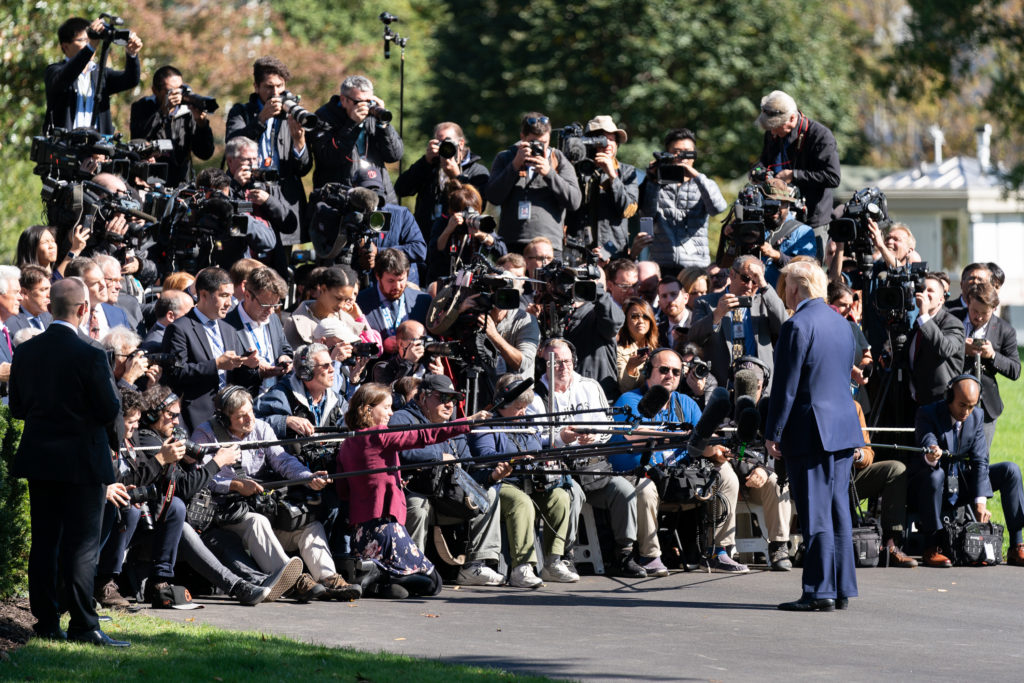
A little later the president approached the rope line on the South Lawn driveway. Uncharacteristically he paused only briefly for a few words and then turned to enter his helicopter, taking no questions. He did make a brief reference to China, the subject crucial to the path of the markets but this week, in the far background.
“When I took office, everybody said that China would be the largest economy in the world within the first two years,” Trump said. “And we picked up trillions and trillions of dollars of worth, and China has lost trillions of dollars of worth.”
So, he continued, “We are far and away the most powerful economy in the world. And if you have a smart President, you’ll stay there.”
Treasury Secretary Steven Mnuchin and U.S Trade Representative Bob Lighhizer will talk to officials in China by telephone on Friday. The APEC meeting in Chile at which he and President Xi could sign the “phase one” trade agreement will happen in mid November. The next date for the imposition of increased U.S. tariffs in mid December is less than 50 days away.
In midafternoon, in Pittsburgh, Trump recapped most of the talking points he has used in recent campaign rallies, using an angry shouting voice directed at a relatively small but enthusiastic crowd of a few more than 1,000. They had been invited by the Republican National Committee to an an event commemorating the advances made in shale oil recovery and were separate from the industry officials also present.
The pool report said, “The speech drew steady cheers from Trump supporters at the back of the convention center, and the occasional confused look from others seated at conference tables closer to the stage.”
When the president returned to the White House at sundown he once again ignored the ropeline, waving but taking no questions.
On Capitol Hill, where Republicans have been advised by leadership to concentrate on criticizing the way the Democrats are conducting their impeachment inquiry, especially if they are uneasy with backing his stance on the Ukraine issues, a group of House members who were not members of the investigating committees delayed the day’s interview by carrying their cellphones into what is supposed to be a sealed off electronics-free secure area called a “SCIF.” As a result everyone now knows what SCIF stands for: Sensitive Compartmented Information Facility.
Across the street from the White House a 55-year old black man from Pittsburgh held a sign, “Build the Wall,” as he has since May 4, 2018. A former housing policeman whose knees gave out, Kemp Gatewood told Mace News, Trump “is doing a damn good job.”
When he first turned up at Lafayette Square Gatewood was going to stay just two days, he said. He had a dream that someday Trump will discuss the big issues with him for 25 minutes.
A true believer, Gatewood says, “My family are all against Trump and I’m not. I love the guy. He’s one of a kind.”
Surrounding him on all sides but paying him no attention, were a couple dozen people holding anti-Trump signs and banners, playing soft jazz music on their loudspeakers.
—
Contact this reporter at: denny@macenews.com
(Photo credit: Shealah Craighead, The White House)